Showing posts with label ShoreBank. Show all posts

Thursday, September 6, 2018

Crain's: Urban Partnership Bank finds a buyer

Another great article by Crain's Steve Daniels, this time about Urban Partnership Bank:
The ShoreBank saga appears to be nearing a definitive end as south suburban lender Providence Bank & Trust looks to acquire the legendary failed community bank’s successor.

Urban Partnership Bank, the lender established in 2010 to take over the ShoreBank franchise after the high-profile urban community bank’s demise, is throwing in the towel.

The South Side bank has an agreement to sell to Providence Bank & Trust, based in south suburban South Holland, the companies announced today. The deal brings to a close UPB’s effort to continue the “mission” of ShoreBank, for decades a bank renowned for lending actively in low-income urban neighborhoods neglected by other banks until it foundered on hundreds of millions in bad loans following the housing bust and Great Recession.

Still, David Vitale, longtime Chicago banker and chairman of UPB, said in an interview he was pleased to find a buyer interested in furthering ShoreBank’s legacy. Having shrunk dramatically from an asset size that had well exceeded $1 billion, UPB wasn’t able to attain its goals, he said.

“The ability to do what we wanted to do at that scale, with the regulatory costs, put our future into question,” he said. “We’re feeling excited for our customers and our communities that someone was willing to invest in us and our communities.”

Providence Bank & Trust is an interesting story in and of itself. Launched in 2004, just six years before UPB, the bank glided relatively unscathed through the financial crisis when most bank startups from that time frame went belly up. It has 12 branches located mainly in the south suburbs, with a few in northwest Indiana.

The acquisition of UPB will give Providence its first presence in the city.

Describing itself as a “stewardship” bank, Providence donates 10 percent of its profits each year to nonprofits and other causes.
To be honest, I would've liked it if some Black investors who hopefully were unscathed by what happened with Seaway Bank for example could've gotten it. Thus we could have another Black-owned bank in the community. Just shows banking is a very difficult business right now or certainly it always has been.

Friday, February 16, 2018

Crain's: Urban Partnership Bank for sale

https://www.upbnk.com/
Steve Daniels who wrote a number of reports regarding the woes of the former Seaway National Bank, writes about Urban Partnership Bank now seeking a buyer.
Urban Partnership Bank, formed to carry on the mission of ShoreBank following that high-profile community lender's 2010 collapse, is seeking a buyer.

Chicago-based UPB has hired investment bank Sandler O'Neill & Partners to gauge interest as the bank determines whether it should remain a small, independent bank or join forces with a larger player, Chairman David Vitale said in an interview.

UPB was profitable in 2017 for the first time since its inception. It posted earnings of $7.4 million, but that was only after booking $10.6 million held in loan-loss reserves as the quality of the bank's loan portfolio has improved. UPB has shrunk dramatically as it's finally completed the mammoth task of working through thousands of troubled loans made by the old ShoreBank. At year-end its assets were $472 million, less than half its $982 million at the end of 2013. Its workforce of 113 compares with 260 it employed back then.

But, while the bank is far smaller than the old ShoreBank, which had more than $2 billion in assets at its peak, UPB remains an active business lender in its South and West side neighborhoods and holds symbolic importance. The Great Recession claimed all but one of Chicago's black-owned banks, including Seaway Bank & Trust, for decades the largest and most prominent minority bank in town.

UPB isn't black-owned, but it's officially designated a minority bank by virtue of a board with more than half minority representation.
I see an opportunity to bring a Black-owned lender back to our community who says that Liberty Bank on the west side or Illinois Service Federal in Chatham & Bronzeville have to be the only players in our city. Of course while Chairman Vitale would like to see a Black ownership group purchase UPB according this article, that's not the only path to a sale.
But UPB is conducting a broad search for a buyer and will consider becoming part of a far larger, conventional bank, too.

UPB doesn't need the capital, he said. The bank arguably is too small and might be better off as a unit of a better capitalized institution, he said.

"We're supposed to be a billion dollar bank. Now we're a $500 million bank," he said.

Remaining independent is an option, Vitale said. He believes he will know by the spring what course the bank will take.

Vitale said the decision to seek a buyer wasn't due to pressure from investors, most of which are large financial institutions like JPMorgan Chase, Bank of America, Goldman Sachs and Northern Trust. UPB was initially capitalized with more than $140 million those companies provided at the behest of Sheila Bair, then the Federal Deposit Insurance Corp.'s chair, who initially was trying to save ShoreBank.
What will the future hold for UPB? Time will tell and looking forward to finding out.

Monday, January 30, 2017

The future of the Seaway Bank

Does the bank & name survive?
The closure of Seaway Bank and FDIC orchestrated purchase by the State Bank of Texas has certainly come as a huge shock. There have been rumblings that there had been trouble at the bank for the past two years. This even though it was in the news that Seaway Bank within the last three years was actually making a profit.

What this means is that Veranda Dickens is no longer majority owner and Seaway Bancshares holding company no longer own the 52 year old bank. Essentially and perhaps many of you already figured this out, the bank is no longer Black-owned. Regardless as happens in situations like that such as this operations are basically status quo for a while at which point the new ownership starts making decisions that makes sense for them.


Saturday night I saw that Seaway's ig account had been reactivated with the last post was to let the world know that the bank is hiring. Problem is the website is still down unless job seeking individuals should for the moment visit the career page of the State Bank of Texas - which has no job postings at all. BTW, State Bank already has a presence on Devon Avenue so they're not that unfamiliar with the Chicago market.

The reactivation of the bank's ig account could be one indication that the Seaway name will survive. That may mean the brand is still significant and they recognize as an Indian-American owned bank that they will be serving a different market now. I could see them keeping Seaway as a subsidiary until whatever time they may decide to sell the bank. Perhaps depending on whether or not regulators may approve any potential sale. Or whether or not this is a successful enough operation where they will choose to keep the bank.

BTW, we've covered bank closings before especially the ShoreBank closing. We covered that somewhat with all the media attention because of any perceived political favoritism towards them. Seaway had been one of the largest Black-owned banks in the nation until the FDIC and State Bank took over. This is a very significant story and like the closure of ShoreBank takes place directly in our community.

For this new re-iteration of Seaway Bank under non-Black ownership what does the future hold?

Monday, December 16, 2013

Crain's: Why Urban Partnership Bank is downscaling

Photo by reallyboring/flickr
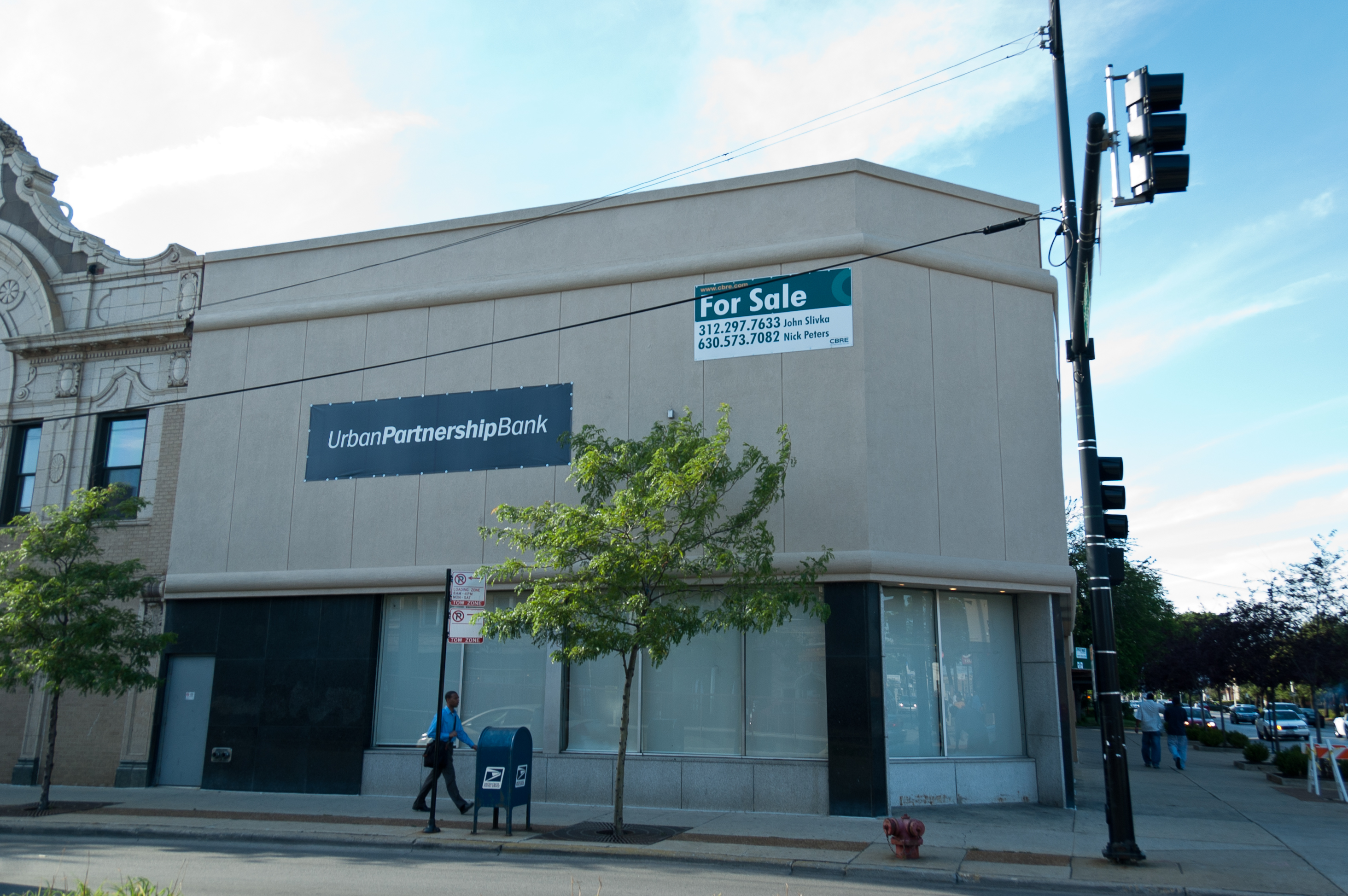
Speaking of South Shore, I've already heard about Urban Partnership Bank putting their HQ on 71st/Jeffrey on sale within the last two years or so. It appears they're even more serious about it.
In a jarring and starkly symbolic move, UPB is selling the old converted movie theater in Chicago's South Shore neighborhood that served for decades as home to South Shore Bank, later renamed ShoreBank. Beginning March 22, UPB won't have a physical presence in South Shore, where ShoreBank co-founders Ronald Grzywinski and Mary Houghton won renown as the only bankers willing to lend to housing rehabbers during the era of white flight that decimated once-thriving South Shore.

“Buildings have useful lives,” UPB CEO William Farrow says. “We determined that building is past its useful life.”

Mr. Farrow says he hopes to re-establish a retail presence in South Shore as part of the redevelopment of UPB-owned lots on 71st Street. That project will be led by Chicago-based Monroe Investment Partners, which is buying the former theater and two other sites. Monroe was responsible for the development that brought Wal-Mart to the Chatham neighborhood on the South Side.

But Mr. Farrow acknowledges that UPB may not have a location in South Shore—where retail development has suffered as unemployment and crime have increased—for some time. In the meantime, customers of the South Shore branch will be offered tutorials on using UPB's new mobile banking app.

There are risks tied to planning a retail redevelopment in such a hard-hit area, but retaining UPB's nearly empty office building wasn't going to help South Shore recover, Mr. Farrow argues.

“Either you are going to take some shots and try to build those communities (like South Shore), or they're going to die,” he says.
Urban Partnership bought the assets of the old Shore Bank that failed in 2010. The new bank is still suffering for some of the old banks losses:
Despite the positive signs, managing ShoreBank's legacy of bad loans surprisingly is growing more expensive with the passage of time. The net ShoreBank-related cost to UPB was at least $12.5 million through Sept. 30, compared with about $12 million in the same period the year before, the bank says. UPB posted an overall loss of $11 million in the first three quarters of 2013. A year ago, Mr. Farrow had hoped to become profitable by the fourth quarter of 2013. Now he won't promise UPB will be back in the black in 2014.
Speaking of Walmart, if you paid a visit to the new Walmart in Pullman you might see a bank branch in there:
UPB also will offer a check cashing service to noncustomers that will undercut the prices typically charged by currency exchanges—a potentially significant initiative that could give the many South Siders without a bank a reasonably priced alternative. That will be rolled out first in UPB's branch within the new Wal-Mart superstore in the Pullman neighborhood on the far South Side. That branch, open just two months, already has attracted more than 200 deposit customers who weren't using a bank before.
The article is certainly making a case that Urban Partnership is seeking to truly differentiate itself from the old Shore Bank.

Wednesday, November 30, 2011

Thinking about the significance of Shore Bank

The following post was supposed to have been posted around June 21 of this year. While not quite as timely, it is still relevant as we just had a "Shop Local Day", and Urban Partnership, which has replaced Shore Bank as a corporation, still has many of the same staff and the same local attitude that made it a vital institution in our neighborhood.

This is a comment Worlee made on the Chatham Avalon Park Community Council blog, also note that Worlee made similar comments posted last month (May) on this blog.
While to most, this is just another bank failure but if Shorebank fails it will wipe away over 40 years of history and progress of the Chatham community.

ShoreBank started as South Shore Bank was started by a multicultural group of individuals to address the lack of capital available to individuals in South Shore as the community changed from being a primarily White Jewish community to African American.

Independence Bank was started at 79th Cottage Grove by a group of African American business men who decided they would control their destiny by creating a bank that would serve African Americans.

In the mid 80's these two banks merged together to create ShoreBank as we know it today.

The combined entities continued to carry out its mission of giving access to capital to those who traditionally were denied access. This access has allowed our community based organizations, social service agencies, churches, real estate investors and homeowners to help build our community.

Although we now have several commercial banking organizations entering the community, the loss of a true "community bank" like ShoreBank which makes decisions based on what is best for its customers and the community, would be a major blow we can ill afford to imagine.

The financial situations of Illinois Service Federal, Seaway and Highland Bank are questionable and the takeover of ShoreBank by an institution with no history in the Chatham community or commitment to serving Chicago ’s urban neighborhoods is sure to lessen the likelihood of an inclusive economic recovery.
I thought these comments were very significant.

What are your experiences with community banks such as Shore Bank and others?

Monday, July 25, 2011

YoChicago: All about Chicago's Chatham neighborhood cont'd

[VIDEO: PART 5, PART 6, PART 7] These are the final three videos of Worlee's drive with Joe Zekas of YoChicago.com.  The videos are posted below the text and here are the first four videos.

Part 5 shows Worlee driving along 83rd onto Cottage Grove then onto 83rd then back onto King Drive. Seen here is Chatham Village Square shopping center where Joe Zekas said he was kicked out while filming close to four years ago. We see an update on the former Chatham Pancake House and also Seaway Bank is shown.

Part 6 we see the last cab stand in Chicago. Also the history of the property near 80th & King Drive. Had little idea it used to be an ice cream stand for Baldwin Ice Cream back in the day. And then a drive along 79th Street from King Drive where it was noted by Zekas that this strip needs some help. In addition we see the LEED certified Chatham Executive Building near the end of this video

Part 7 we see more of 79th Street with Rep. Bobby Rush's Congressional Office and I believe they make special note of the "Chatham Center" near 79th & Cottage Grove. In addition we take a look at a branch of Urban Partnership Bank. This branch was formerly of ShoreBank and was the main bank for the former Black-owned Independence Bank.

Back to 79th Street we see some of the buildings on the north side of the street from the "Chatham Center". One of those storefronts back in 1995 was I believe a campaign office for Mayor Daley when he ran for re-election at the time. Was even close enough to shake hands with him back then.

Anyway the videos are embedded below. Did you enjoy all seven videos?

Friday, March 11, 2011

FDIC finds no political influence in ShoreBank's attempted save

Before ShoreBank was taken over last year there were many who decried (even organized a tea party near the downtown offices of ShoreBank) whatever political connnection they had to survive. Not sure the FDIC's report would put a rest to those accusations. As weall know ShoreBank is now Urban Partnership Bank:
During the tortured effort to rescue failing South Side lender ShoreBank last year, Federal Deposit Insurance Corp. Chairman Sheila Bair called Wall Street banks soliciting investments in the bank, but a new report by the FDIC's inspector general concluded the intervention wasn't inappropriate.

The report, released Thursday, also disclosed that the estimated loss to the FDIC's insurance fund from ShoreBank's failure has grown substantially since its August failure. As of January, it stands at $452 million, up from the $329 million the FDIC announced when it closed the bank last year and sold the deposits and assets to newly formed Urban Partnership Bank.

The higher estimate was due to “asset recovery assumptions and liquidation information,” the report said.

The FDIC's inspector general was asked by Republican leaders on the House Financial Services Committee to look into whether there was undue political influence in the attempt to bail out ShoreBank, the $2.2-billion-asset bank that gained national renown for lending in low-income urban communities.

Monday, February 7, 2011

Community banking: ShoreBank's new name and mission


I intended to post the video above before the blizzard hit, but now is as good an opportunity as any.

There's also this story from CPR:
Some five months later, ShoreBank has new owners and a new name – Urban Partnership Bank. But is their mission the same? And how are they managing the troubled loans that helped lead to the closure of ShoreBank?

Eight Forty-Eight
spoke to William Farrow, President and CEO of Urban Partnership Bank to find out.
Listen to the audio!

Tuesday, February 1, 2011

CRAIN'S: ShoreBank’s new managers outline plans under Urban Partnership Bank

Click pic for bank's website
Well ShoreBank has been dead since August and their successors at Urban Partnership Bank is making even more plans for the future of that institution. More from Crain's:
The two former First Chicago Corp. executives running the successor to failed ShoreBank have more modest aims than the bank’s co-founders did. Rather than looking to construct a model of inner-city lending for other cities in the U.S. and abroad, the new managers simply want to create a profitable bank that makes its existing communities better and more vibrant.

In an interview Tuesday, Urban Partnership Bank Chairman David Vitale and CEO William Farrow outlined plans to transform the old ShoreBank from a real estate-focused institution into a more full-service, conventional bank providing modern deposit and payment services to consumers and loans to a wider array of businesses.

The two have no plans to increase the size of the bank, which used $140 million in capital from many of the largest financial firms in the country to purchase the assets and deposits of ShoreBank after regulators seized it last August. But that doesn’t mean the bank, with $1.4 billion in assets, can sit still, since a healthy percentage of those assets are bad loans that will need to be replaced by new loans.

In the meantime, they want to position Urban Partnership Bank as a lower-cost competitor to currency exchanges and other cash-checking outlets, providing transactional services like prepaid cards to the many South and West side consumers who don’t have bank relationships.
 
This approach might be necessary especially in the Chatham neighborhood which while may not be home to many Currency Exchanges, from what I can tell, but could use more services for the businessowner/entrepreneur.

Tuesday, January 4, 2011

Urban Partnership Bank shutting Kenwood, Bronzeville branches

More changes at the former ShoreBank:
The branches at 3401 S. King Drive and 4659 S. Cottage Grove Ave. will close on March 17.

Also closing on that date will be the bank's non-profit service center at 134 N. LaSalle St. and its single branch in Cleveland. The news was first reported on the Chicago Tribune's website.

The bank has seven other remaining locations in Chicago and one location in Detroit.

A spokesman for Urban Partnership Bank, which rose out of the ashes of the failed ShoreBank, said that the financial institution is seeking "more accessible and convenient locations" to serve customers in Kenwood and Bronzeville and in Cleveland. He added that in the case of Cleveland, the bank is hoping to add retail services to the future new location.

Monday, December 13, 2010

The myths of ShoreBank’s failure

Curtis Black:
The conservative contention that ShoreBank was politically favored, with connections to Presidents Clinton and Obama among others, might have been rendered moot when the FDIC closed the bank in August.  But Fernholz notes “a new conservative conspiracy theory” – “regulators were letting the FDIC’s insurance fund absorb losses so that the social experiment could start anew.”

In fact the consoritum of investors who formed Urban Partnership Bank was tagged to purchase the bank’s assets only after hundreds of banks passed on the same opportunity.  And the new operation will share ShoreBank’s losses with the FDIC, which would have been on the hook for the entire bill otherwise.

Now “ShoreBank’s experience is being taken as a call to end government support for community lenders, as though encouraging credit access in underserved communities is the moral equivalent of bailing out Wall Street’s megabanks,” says Fernholz.  (This echoes the contention that the Community Reinvestment Act caused the crash by requiring investment in low-income communities; but the bulk of subprime loans came from unregulated mortgage companies and investment banks, and their securitization was a project of the higest rollers.)

Fernholz argues instead that ShoreBank’s experience is emblematic of the challenges facing small banks.  And he cites bankers who say “ShoreBank’s failure was less because of its mission and more because of its busienss practices” – it “tried to accomplish too much, too fast.”
Read the whole thing.

BTW, I noticed that the Chatham facility of the new Urban Partnership Bank was finally adorned with the name of the new entity instead of ShoreBank at least a week ago.

Monday, October 25, 2010

Seaway Bank buys Maywood bank assets

Chatham's own Seaway bank has bought the assets of First Suburban National Bank of Maywood. This is ironic, as ShoreBank (with a significant Chatham presence) was in Maywood's situation recently.

From Chicago Breaking Business News :

Regulators have shut down First Suburban National Bank of Maywood, Ill., late Friday and sold its $140 million in deposits to Seaway Bank and Trust Co. of Chicago.

Depositors of the First Suburban National Bank will be protected by the purchase deal with Seaway Bank and Trust. The four branches of First Suburban National Bank will reopen Saturday as branches of Seaway Bank and Trust. Seaway did not pay a premium

Saturday, August 28, 2010

Urban Partnership Bank, formerly ShoreBank, names new directors

Crain's:
Urban Partnership Bank, which rose out of the ashes last week of failed ShoreBank, has created a board of directors that has five members so far.

In addition to the two top bank managers of David Vitale and William Farrow, the board currently includes Eileen Kennedy, Daniel Lupiani and Jerome Szott, according to a Friday report on the Chicago Tribune's Web site.

An Urban Partnership Bank spokesman said Friday that the final size of the board has not yet been determined.
...
Ms. Kennedy and Mr. Lupiani are former First Chicago executives and Mr. Szott a former employee of National Bank of Detroit, the Tribune reported.
Vitale of course is the executive chairman of the bank. Farrow is the President and CEO.

Also drove by the Chatham branch and the main branch of the former ShoreBank. Usually the bank brand is changed immediately. What gives this time around?

Saturday, August 21, 2010

ShoreBank failure video on demand

EDIT: Also read the press release from the new Urban Partnership Bank that Worlee posted this morning!

Not to beat a deadhorse here, but I think it's necessary to find some video of this significant south side event. The failure of a well-known community bank that served those underserved neighborhoods. This is significant to this community because ShoreBank bought out the former Independence Bank in the 1990s. ShoreBank survives as Urban Partnership Bank.

First video is from ABC7


This second video is from CBS2. With this quote:
It brought some to tears; it was a community bank.
That story had people who said they were about to cry. It was more than just a bank to them.

This last video is from FOX Chicago with footage from the former HQ of the former Independence Bank at 7936 South Cottage Grove Avenue. There were plenty of shots of the surrounding community on Cottage Grove, especially of the boarded up buildings around that Chatham branch.


Hat-tip CAPCC blog!

Urban Partnership Bank Press Release

Urban Partnership Bank Press Release


It's great to see that the initial mission of Independence Bank will not disappear. With individuals like Mr. Mckeever involved with the bank I think we will see a major turnaround.

NOTE: If this document doesn't load click on the available link at the top. Thanks!

Friday, August 20, 2010

ShoreBank becomes the 15th bank in this state to fail!

While this story from Breaking News is only an update to an earlier story today look for ShoreBank to re-emerge under a new brand, Urban Partnership Bank. Management of the former ShoreBank is expected to bid on the bank's assets.

ShoreBank execs ready to relaunch lender with new name

Crain's:
ShoreBank management have presented a bid to federal regulators for some of the performing loans and deposits of the failing Chicago lender that could lead later today to the creation of a bank with a new name that would continue lending in ShoreBank's South and West Side markets, as well as Cleveland and Detroit, according to people familiar with the matter.

While the ShoreBank name is expected to go away, it couldn't be learned what exactly the new moniker will be. One source said it was likely to include the word “Urban.”
...
Management of ShoreBank, led by former First Chicago Corp. senior executive David Vitale, has lined up most of the Wall Street and other investors that had committed $150 million in the spring to try to save the bank from failure to back a bid for some of ShoreBank's assets and deposits, according to people familiar with the matter. The Federal Deposit Insurance Corp. is expected to seize the bank later today.

If no other surprise bidders have emerged, the management team is expected to acquire some of the bank's deposits and good loans in order to continue ShoreBank's mission of lending in low-income urban neighborhoods avoided by other banks. Mr. Vitale, who agreed to try to save ShoreBank in the spring and is executive chairman, will continue to run the lender.

If the bid is successful, the bank will be limited to its Chicago branches and its smaller operations in Cleveland and Detroit, according to a source.
There you have it, ShoreBank is expected to be seized by the FDIC today. Although in some minor way this bank will survive, but not in the same form that we have known it.

Thursday, August 12, 2010

Clergy comes out to support ShoreBank


ABC reports
Clergy members and community leaders on Chicago's South Side are calling for a moratorium on the closing of community banks.

They say the federal government should do more to save small institutions like the troubled ShoreBank.

State Representative Marlow Colvin says, as a former community organizer, President Obama should understand the importance of small banks to their communities.

"It is who the president is, so we are not asking him to become something he is not, we're asking him to be what we always believed him to be, and that is concerned about these communities," said Marlow.

People attending Thursday's event say, when small banks fail, neighborhoods suffer.

The Wall Street Journal reports that ShoreBank has asked for $75 million from the federal tarp program.

We have talked about ShoreBank and their history that closely tied to Chatham's history as they are the successors to Independence Bank.

Should ShoreBank be bailed out?

Wednesday, August 11, 2010

With ShoreBank on the ropes, two possible scenarios emerge

Looks like ShoreBank will be taken over by the FDIC at some point:
The hour of reckoning is fast approaching for ShoreBank.

All signs now point to the Federal Deposit Insurance Corp. seizing the South Side lender within the next few weeks.

As unlikely as it seems, though, it's still possible that a bank named "ShoreBank" will emerge from the failure with a mission similar to the one it has pursued for more than three decades — lending in low-income urban neighborhoods — beginning in Chicago's South Shore neighborhood in the 1970s.
OK there are two scenarios right. Here they are!
One is a straight liquidation, in which the FDIC would reimburse insured depositors, close the branches and dispose of the assets later. In that scenario, ShoreBank would be consigned to history.

The other is a management-led buyout, most likely funded in large part by some of the investors who committed $150 million to save ShoreBank but whose investment was predicated on an accompanying $75-million federal bailout that now is not forthcoming because of regulators' concerns that it won't be enough to keep the bank solvent.

In that case, the investors would acquire the branches, deposits and some of the good loans — essentially rebooting ShoreBank with a more cautious lending approach — while the FDIC would take on the bad loans for later disposal. Unclear is how much capital would be needed to back this effort, something presumably that management, investors and regulators will grapple with over the coming days.

That second scenario would be the “good bank, bad bank” approach that Fox News first reported earlier this week.

Ordinarily, when the FDIC begins an auction process for a bank that's failing, it takes four to six weeks to sort through the bids and prepare to seize the bank. But ShoreBank already went through that process earlier this year, averting failure at the time after putting together the $150-million rescue package.

As a result, sources say, the FDIC could seize ShoreBank anytime.

To be sure, an eleventh-hour bid with the FDIC by a bank or qualified investment group can't be ruled out, but there aren't any signs of that at the moment.
Now if our local black-owned banks were willing to take up some of those assets from ShoreBank or at least some of those local branches located in black neighborhoods this could be a good thing.