Showing posts with label middle class. Show all posts

Thursday, March 14, 2019

Capitol Fax: Question of the day

To give a short hand of yesterday's question of the day from CapFax, "What constitutional provisions, if any, would you support to “protect” middle-class families from future tax increases after the new graduated tax structure takes effect?"
Well I haven't seen the responses there, but hopefully someone out there who has great familiarity with the state constitution and taxation has their own answers.

Monday, March 4, 2019

EDITORIAL: The next mayor of Chicago must bring back the middle class #ChiMayor19

Perhaps Preckwinkle & Lightfoot will have an answer to this Sun-Times editorial as they head to the their April run-off.
A city without a middle class is no place to be. It is a ladder with a few rungs at the top and a few at the bottom — and none in the middle. It is a place where the social mobility essential to a democracy — the ability to climb the ladder of success — becomes prohibitively difficult, if even possible.

The next mayor of Chicago may argue that the biggest challenge facing our city is getting its finances in order, or improving its schools, or curbing violent crime. But all those challenges must be met in ways that pull the whole city along — that create opportunities for the poor to move up and for the last of the middle class to stick around.

Or what’s the point?
I would like to refer you to a previous post which involved a piece from WBEZ regarding Chicago's shrinking middle class.

Wednesday, February 20, 2019

WBEZ: The city’s middle class, once the backbone of Chicago, is declining so swiftly that it’s almost gone

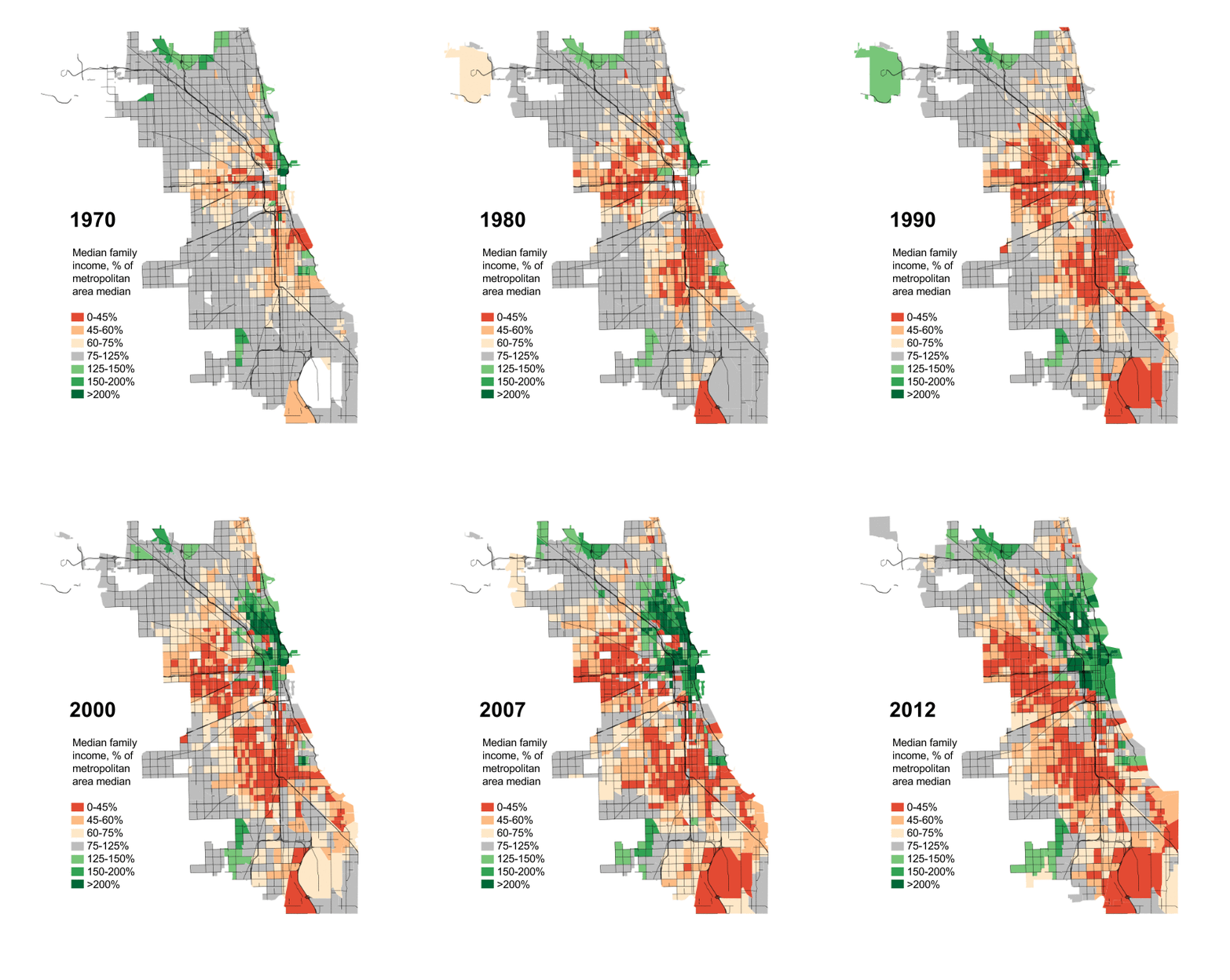
Back to one of the subjects this blog had hoped to cover, the middle class. Chicago's middle class is shrinking according to this article from WBEZ. Increasingly Chicago is becoming home to not only higher income people, also lower income people as well.
Chicago has long been defined by its stubborn racial segregation, but income segregation is “more extreme now” than in the past, Smith said.

Many of the neighborhoods that were middle income in 1970 are now lower income.

“But what's been more striking is a significant increase in high-income people moving into the city,” Smith said.

Just 8 percent of Chicago's census tracts were considered high or very high income in 1970. Today, more than one-fifth of the city’s census tracts are higher income.
 

Saturday, October 20, 2018

San Francisco's narrowing middle-class

I found this article from this past summer from Newsalert, San Francisco have some much more serious problems and it involves the proliferation of excrement on public sidewalks. Regardless it shouldn't be a huge surprise that it's expensive to live in San Fran.
San Francisco’s narrowing middle class, already squeezed by the high cost of living could take another hit if a new business tax is approved in the November election, according to the city’s Office of Economic and Workforce Development.

The measure, approved for November’s ballot last month, would levy an average of about 0.5 percent gross receipts tax on companies that make $50 million or more in revenue. In return, it would roughly double the city’s funding for housing and homeless services, such as 1,000 extra shelter beds and services for the mentally ill.

Homelessness activists, nonprofits and community groups strongly support the measure, saying it’s time for the city’s businesses to do more to alleviate San Francisco’s homeless population.

But, according to a memo sent to the mayor’s office by the Office of Economic and Workforce Development last week and obtained by The Chronicle, the extra tax would disproportionately impact employees in mid-level jobs, such as administrative staff in retail companies and grocery store workers.

“There is a limit on how high taxes can go before you decide to go to Oakland, where the taxes are much, much lower,” Jim Lazarus, senior vice president of public policy for the San Francisco Chamber of Commerce, said of businesses located in the city. “There are companies in San Francisco that pay more San Francisco tax than they pay in other states.”
One of the main points of this blog is to talk about urban middle-class issues and as I share this my hope is that Chicago doesn't begin to have those issues. Our city should be for everyone low-income, middle-class, or wealthy.

I'm sorry that I didn't share a timely article as it was published in the San Francisco chronicle in August almost a month before Mayor Emanuel's surprise announcement to forgo running for a third term. One of the issues hopefully mayoral candidates could address in 2019 is whether or not there is a plan to make Chicago affordable for any middle-class families or people.

Tuesday, October 9, 2018

CapFax: Pritzker now won’t define what “middle class income” is

[VIDEO] All I can say to this is ouch Pritzker, ouch. The Democrat nominee for Illinois governor won't define what income levels would be considered middle-class. I suppose this might mean he doesn't have a grasp on those middle-class families who are leaving Illinois.

The video above was provided by CapFax and will share link to that blog post below!

Wednesday, September 26, 2018

Business Insider: Middle-class Americans made more money last year than ever before

Sometimes, I wish I had done more looking into being middle-class in America (well for sure being middle-class in Chicago). Doing research on being middle-class or black & middle-class it seems finding some materials - especially news items - can be difficult. Regardless through the FB page of the 6th Ward Republican Organization this article on the middle-class booming in this nation:
America's middle class is booming.

Between 2015 and 2016, US median household income rose 3.2% from $57,230 to $59,039, according to a new reportreleased by the U.S. Census Bureau on Tuesday.

It's now the highest income year on record, beating the previous high of $58,655 in 1999 (all numbers are adjusted for inflation).

The US poverty rate simultaneously declined about 1% to 12.7%, returning to nearly the same level as in 2007, prior to the recession. In total, 2.5 million fewer people were in poverty in 2016 than in 2015.

Plus, almost every demographic group experienced a rise in incomes last year, according to the Census, thanks to more Americans securing full-time and better-paying jobs — a total year-over-year rise of about 2.2 million workers.
Now I look forward to any article from our local news outlets letting us know of a "booming" middle-class in the city. Especially on the south and west sides of Chicago. Will any of the aspirants for the mayor's office talk about keeping middle-calls people in the city?

Wednesday, June 27, 2018

NY Post: Why the middle class can’t afford life in America anymore

For the most part I started this blog to discuss the middle-class enclave of Chatham. It's been a while since we've really discussed middle-class issues. So here's a recent NY Post article about how middle-class families can't afford the standard of living in this nation:
After spending his days teaching AP American history and economics at the public Live Oak High School in San Jose, Calif., Matt Barry drives for Uber.

Barry’s wife, Nicole, teaches as well — they each earn $69,000, a combined salary that not long ago was enough to afford a comfortable family life. But due to the astronomical costs in his area, including real estate — a 1,500-square-foot “starter home” costs $680,000 — driving for Uber was a necessity.

“Teachers are killing themselves,” Barry says in the new book, “Squeezed: Why Our Families Can’t Afford America” (Ecco), out Tuesday. “I shouldn’t be having to drive Uber at eight o’clock at night on a weekday. I just shut down from the mental toll: grading papers between rides, thinking of what I could be doing instead of driving — like creating a curriculum.”

In her book, author Alissa Quart lays out how America’s middle class is being wiped out by the cost of living far outpacing salaries while a slew of traditionally secure professions — like teaching — can no longer guarantee a stable enough income to clothe and feed a family.
Reading this article it seems this issue is directed towards teachers whether at K-12 or at universities. Of course more broadly the article notes:
“Middle-class life is now 30 percent more expensive than it was 20 years ago,” Quart writes, citing the costs of housing, education, health care and child care in particular. “In some cases the cost of daily life over the last 20 years has doubled.”

In one of her book’s many striking findings, Quart writes that according to a Pew study, “Before the 2008 crash, only one-quarter of Americans viewed themselves as lower class or lower-middle class. No longer. After the recession of 2008 . . . a full 40 percent of Americans viewed themselves as being at the bottom of the pyramid.”

One of the book’s main messages, therefore, is that people finding it impossible to make ends meet shouldn’t blame themselves. It’s the system, she says, that’s broken.

“The main problem is a basic lack of a 21st century safety net for families,” Quart tells The Post, offering the cost of day care as just one example.
Read the whole thing

Monday, June 26, 2017

Against All Odds: The Fight for the Black Middle Class

[VIDEO] One of the main reasons why I started The Sixth Ward was to in some way highlight the middle-class aspects of the 6th Ward as it was drawn between 2002 to roughly 2015. Chatham isn't the only community with a solidly Black middle-class population, but it has often been considered a bastion of the Black middle-class.

This documentary was mentioned on the ig profile for the new owners of the former Seaway National Bank - Self-Help FCU - doing a quick mention of this documentary Against All Odds: The Fight for the Black Middle Class. It's available for viewing either on pbs.org or you can watch it through the PBS app available on iPhones & iPads and likely Android also.

Sunday, March 5, 2017

WBEZ: Black Homeownership - The Promise and The Pitfalls

Via The Chicago Neighborhoods
JP Paulus shared this post on our FB page and I basically got stuck on the "black tax" what does this even mean?
But Chatham was no urban Mayberry. When I was in high school, the “Chatham rapist” stalked the neighborhood. On more than one occasion, thieves broke into our garage.

“There was crime in the neighborhood, although it was a very nice neighborhood,” my mom said. “But you would hear about robberies in the area, so that was a downfall, I think.”

This is part of what’s called the black tax. Black middle-class neighborhoods are more affected by urban ills than white middle-class neighborhoods; you have to deal with more poverty, more crime, worse schools and fewer services.
Another example of this black tax:
My dad said he saw the black tax even when he shopped at a Jewel grocery in the neighborhood.

“When I wanted to pay for the groceries by check, I had to almost get my birth certificate for ID,” he recalled.

But then he went to a Jewel in neighboring Evergreen Park, where he didn’t have to show any ID. He also noticed the prices were lower. When he asked why the prices were higher at the Chatham store, he was told the store had to pay for security.

“There is a shortcoming of living in an all-black neighborhood, even one as affluent as Chatham,” he said.
Basically the article discusses Black homeownership in mostly Black areas vs. integrated areas. Reporter Natalie Moore discusses choosing to own a condo in Bronzeville - an area we hear had been on the upswing - vs. renting in more intergrated Hyde Park.

Her own parents ultimately left Chatham and moved further southwest to Beverly:
My parents made a good decision, but they also got lucky. They bought the Chatham home in 1974 for $30,000 and sold it almost 20 years later for more than four times that amount. By 2010, Chatham was going through rocky times. U.S. Census Bureau figures show population loss, decreased median income and plummeting home values.

There was also the housing collapse. Black homeowners were set up, by certain lending practices, to take a harder hit than whites. Subprime loans were targeted at black homeowners, and those loans were concentrated in black neighborhoods, like Chatham.

My parents left before the collapse, and the devastation of the housing crash didn’t hit their new neighborhood like it did in Chatham. Their new home -- a four-bedroom, mid-century modern split level -- is located in a housing market with stable home values.

My parents told me their decision to move into an integrated neighborhood -- Beverly is 62 percent white and 34 percent black -- has paid off. Blacks have far less equity in their homes. That changes if you live in an integrated or white neighborhood.
Why should ethnicity in a neighborhood make a difference as far as equity?

Tuesday, October 4, 2016

Vocalo: Chatham Changes


[AUDIO] The Vocalo's Barber Shop show discusses the current state of Chatham with journalists from City Bureau. Duration of this program is 48 minutes.

Having listened to this clip they talk to the owner of Dat Donut on 83rd & Cottage Grove. Also a question comes up about how we can bring the younger generation - millennials to the Chatham neighborhood for it's revitalization.

Bringing in millennials is something hinted in a post regarding Englewood and how that neighborhood could change in the future with an influx of new residents. Perhaps that's Chatham's future also.

Another important aspect of this discussion is the state of the Black middle class.

Tuesday, April 26, 2016

The quiet desperation of the middle class

Read this article from The Atlantic. Rich Miller of the Capitol Fax blog shared it today.

Over the years on this blog I have written about middle-class issues. Especially important since I created this blog to discuss neighborhoods such as Chatham.


I've learned over the years that the position of the Black middle-class is often precarious. It often seems being middle-class in this nation is just as precarious.


If you read this article feel free to offer your thoughts.

Saturday, January 17, 2015

Today's middle-class readings...

Over the years decidedly I often posted articles that in general pertained to the middle-class with a strong interest in the Black middle-class. It's only appropriate since we wanted to be the neighborhood blog for the 6th Ward as historically that area has been home of Chicago's Black middle-class.

So recently I found two articles that hopefully you'll consider at your convenience. Although we would like to see articles about Chicago's Black middle-class, often I find articles about that same demographic from other cities. In this case one out of New York City and the other out of Detroit.

In the case of New York via the Wall Street Journal written last November:
New York City’s black upper-middle class is fading, while its populations of upper-class white singles and lower-income Hispanics are booming, according to a new report that adds to concerns about a struggling middle class and growing income divide.

Between 2000 and 2010, neighborhoods dominated by the city’s black upper-middle-class residents experienced an 18.9% population decline.

Places such as Woodlawn in the Bronx and Hollis in Queens that were once affluent enclaves of upwardly mobile African-Americans saw a growth in low-income black households at their fringes. These neighborhoods have also had high rates of foreclosure.
It seems that in some of Chicago's Black communities foreclosure has been a major issue. And this has also been a major issue apparently in the Bronx & Queens in New York.

Now here's Detroit from July 2013 via The New Yorker....strangely enough. Anyway it discusses the middle-class in general there, however, they start off with a Black couple who moved into a white neighborhood 40 years ago:
In 1973, Ron and Loretta Martin and their three sons moved into the yellow-brick Colonial across the street from my childhood home, on Detroit’s west side. My father greeted them warmly, despite the fact that most of our neighbors saw them as blockbusters, part of a nefarious conspiracy by civil-rights groups to force integration and break up tight-knit white enclaves. The Martins were one of the first black families on our block. It took a lot of courage to be pioneers, those black families who crossed the city’s racial frontier. And it also took extra money. Black pioneers, as I discovered years later when I wrote a book about Detroit, were usually better off financially than the white people they moved next to. They had to be. Brokers regularly charged blacks a premium to buy or rent in what they hoped would be a safe, secure, integrated neighborhood.

Ron and Loretta were pioneers in another way. He was a police officer, she was a school teacher, and both were at the vanguard of a new generation of black Americans who vaulted into the middle class through public employment. Today, government employment, however fragile, is the mainstay of Detroit’s economy. At the beginning of 2013, the public sector directly provided more than forty thousand jobs in the city. Among Detroit’s top five employers are the city itself, the Detroit public schools, and the federal government. By contrast, the last two automakers with substantial operations in the city, Chrysler and General Motors, employ only about four thousand workers each.

It was not always this way. For most of the city’s history, there weren’t many Ron and Loretta Martins. The traditional avenue to a life of at least modest comfort for black Detroiters—at least after the Second World War, when the factory gates opened up—was the auto industry. The jobs were unionized, and they offered generous health and pension benefits. For the refugees from Jim Crow who’d come to the city, it was a big step up from the drudgery of tenant farming or cleaning houses.

But by the time the Martins moved in, those blue-collar jobs were disappearing. Beginning in the early nineteen-fifties, Detroit steadily hemorrhaged manufacturing jobs, losing them to outlying suburbs, small towns, the Sunbelt, and, over time, to Canada, Mexico, and overseas. Today, there is only one auto-assembly plant fully within the boundaries of Detroit.
What do you all think? Could these articles relate to what's going on in Chicago?

Friday, September 5, 2014

Crain's: Where does Chicago's black middle class live?

Click for larger resolution
In April of this year we posted an animated map showing Chicago's vanishing middle-class. It was from the City Notes website who's author - Daniel Kay Hertz - wrote a recent op-ed to Crain's Chicago Business. That earlier map was interesting as it tracked the income of the many census tracts that make up the City of Chicago.

Now with the map you see above we show a different tact: Where does Chicago's Black middle-class live?

To be sure, the Black middle-class lives throughout the city. They no longer just live in Chatham or Pill Hill although perhaps they were never the exclusive home of the Black middle-class. The maps shown in the Crain's op-ed seems to show the Black-led middle-class households but mainly measures them as a percentage or as numbers. Also they show maps of Asian, Latino, or white middle-class households in Chicago.

Even Mr. Hertz will admit that the maps provided are misleading and it's hard for me to believe that in some of the community areas there are Black middle-class people in those areas that aren't largely Black. The map you see above I would consider much more accurate.

Hertz offer these brief notes:
A FEW NOTES ON THE WHOLE THING

1. The black middle class exists in Chicago. In large numbers. This shouldn't really be news, but speaking in my capacity as a white person who knows a lot of white people and other people of various ethnic backgrounds from the North Side and suburbs and other parts of the country/world, it really is.

2. Perhaps even more important, the vast majority of Chicagoans who are both black and middle-class live on the South Side and, to a lesser extent, the West Side.

3. The concentration of middle-class households varies dramatically from one black neighborhood to another.

4. Still, the majority of Chicagoans who are middle-class and black live in neighborhoods that are mostly not middle-class — as opposed to Chicagoans who are middle-class and white, for whom the opposite is true. In this way, Chicago is pretty similar to the rest of the country.

The takeaway for me is that these maps contradict two of the biggest lies — or, if we're being kind, misconceptions — about the social geography of Chicago. The first is that the black neighborhoods of the South and West sides are an undifferentiated landscape of economic hardship. This is false in a couple of ways. For one, though there are many people who are suffering for want of a decent wage in these areas, there are also many thousands of households that are not (though they are likely still disadvantaged by other consequences of segregation, including poor access to jobs and basic amenities, higher crime, lower-performing schools, etc.).
And here's another good point:
 From a governance perspective, there are lots of reasons you'd want the people in charge of a city to have an accurate impression of the communities they're governing before they start making up policies for them. But also, from a purely social point of view, the fact that most non-black Chicagoans — and the vast majority of non-Chicagoans — can't distinguish between the poorest pockets of the city and places like Calumet Heights or Park Manor means that they won't ever visit, spend money and certainly won't consider living in neighborhoods that they likely would find generally pleasant. In short, it's hard to build much of a local economy in a place that 75 percent of the population shuns without even thinking about it.
Something to think about. Even then, what could residents of these "shunned" communities do to attract people to their neighborhoods even to just visit?

You should read the whole thing when you get an opportunity.

Tuesday, July 22, 2014

WBEZ: Neighborhood value a challenge for housing recovery

I only wonder how widespread this is. Buying property is all about location and this is anywhere. However, what if it was even difficult to get a bank loan on a property in a distressed area as this case illustrated:
This happened to my friend Leila Noelliste. Her middle class family wanted to put down roots in North Lawndale on the West Side of the city. Last year, 80 percent of its total residential property sales were cash transactions and nearly a quarter were considered extremely low value, like about the price of a car.

Noelliste wasn’t making a cash purchase. She offered $182,000 for a two- flat in the neighborhood.

“When we got it inspected, it was really sturdy. Good foundation, good roof, didn’t need a lot of repairs,” she said. “There were two sets of tenants living in it. It was just a good building on a good block.”

She had plans for her family to live in one unit while renting out the other. But those plans came to a halt because of the home’s value --its appraisal.

“It was appraised for like in the 140s. And we were shocked. I mean, I know this isn’t a great area, but that just seemed really, really low,” she said.

The bank would only finance a loan for the appraised amount. Noelliste and her husband Norman Baldwin didn’t have the out of pocket money to pay the extra $40,000 on top of a down payment, so they had to move on.
...
A less than 10-minute drive brings you to the Near West Side, where Leila ended up buying a home.

“Upstairs we have a master bedroom with a walk-in closet, with a master bathroom. And then we have two smaller bedrooms. One of the bedrooms we use as my office-guest room. And the other room, my son is in. So it’s a beautiful home,” Noelliste said.

They offered $285,000 for the place, and it was accepted..

“My credit was good, Norm’s credit was good. We had a lot in our savings. All it was [the lower appraisal on the two-flat] was the value of the house. That’s all it boiled down to. Which is baffling, very, very frustrating,” she said.

Here’s a family now living in a $285,000 house, but couldn’t get the financing for a place $100,000 cheaper in a less desirable neighborhood.
I wonder how this is possible, if only I knew people who were involved with mortgages, real estate, and finance.

Beyond that read the whole article.

Saturday, April 19, 2014

City Journal: Chicago's Vanishing Middle Class


Click for larger resolution
This article by Aaron Renn who writes The Urbanophile blog further discusses Chicago's vanishing middle class. Earlier this month I showed an animated image that illustrated middle class areas go from either very wealthy to very poor since 1970s. That image you will see to the right.

If you believe that Mayor Rahm Emanuel may not be entirely responsive to the plight of middle class people in the city perhaps there are some political aspects involved:
The plight of the middle class in cities like Chicago can’t be blamed entirely on liberal policies. The global economy has clearly benefited the talented, the educated, and the already wealthy, often at the expense of those in formerly middle-class occupations, like manufacturing. And it’s unlikely that the forces unleashed by globalization will diminish. One might expect, then, that big-city Democratic leaders like Emanuel or de Blasio would make a strong appeal to middle-class constituents.

They haven’t, because for liberal mayors, middle-class decline is convenient and politically advantageous. Much of America’s moneyed elite has already shifted its allegiance to the Left, especially in cities. Wealthy, educated urbanites hold generally liberal social values and can afford the higher taxes “blue” cities like Chicago impose—especially when those taxes help pay for the upscale amenities they desire. Even when the mayoral administration is less friendly, the urban elite tends to get its needs met. At the same time, the urban poor have remained loyal to the Democrats, no matter how little tangible improvement liberal policies make in their lives. And the various unions, community organizers, and activist groups that advocate for the poor profit handsomely from the moneys directed toward liberal antipoverty programs.

This is the Democratic Party’s new top-bottom coalition, one in which the traditional middle class—white ethnics, blue-collar manufacturing and trade workers, small business owners, and others—has no part. These “left-outs” are the urban equivalents of Reagan Democrats. Their instinct to vote Democratic may remain, but the economic interests that once bound them to the party have largely disappeared, leaving them politically unaffiliated. They are open to voting for a compelling Republican, such as Rudolph Giuliani—particularly if the city in which they live appears to be spiraling downward.

In other words, these independent-minded, urban middle classes are quintessential swing voters. They can create political trouble for an unsympathetic mayor—and that’s why leaders in Chicago, New York, and elsewhere aren’t going to lift a finger to try to halt their flight. Indeed, in Chicago, even the black middle class is bailing. The city’s leadership appears unconcerned.
Read the whole thing!

Sunday, April 6, 2014

City Notes: Watch Chicago’s middle class vanish before your very eyes

Click pic for larger resolution
I'm sorry I missed this as this was shared on Friday via The Capitol Fax. The animated image you see above is a documentation of Chicago's shrinking middle-class since 1970. The middle-class areas are those you will see in grey. Bascially this map measures "each Census tract’s median family income as a percentage of the median family income for the Chicago metropolitan region as a whole".

It's interesting to read the comments on both sites although unfourtately CapFax has since closed their comments for the weekend. That doesn't mean we can't continue to discuss the many changes and the factors that cause the middle-class to leave the city.

BTW, last year I posted one factor why middle-class families move to the suburbs and then recently found another article which chronicled another city family who is leaving the city. These families blame CPS schools for their decision. Perhaps it's one reason amongst others and the City Notes post seeks to further explain the shrinkage.

Either way I'm sure there are plenty of ideas to discuss this issue.

Friday, September 27, 2013

Reader: Three families tell us why they ditched CPS

Graphic from Chicago Reader
In reading this I did the usually unthinkable, taking a physical copy of the Chicago Reader and read this article. I basically read about the first family skipped the second and hoped to see an opinion from a "minority" group. That's the last family you see here and the family that likely represents a majority of students at CPS at least ethnically.

Unfortunately these three families are troubled by the issues that occur in many of our neighborhood schools. They made the move to suburban areas because of it. Before they talk to the individual families therein, they make sure to point out why CPS needs families such as those in the article:
The exodus has had a deleterious impact on the city's schools. Middle-class parents tend to be zealous advocates. They're more likely to know an alderman or a reporter, and make noise about a problem their children's school is facing. The clout of a school system as a whole increases when middle-class parents have a stake in it. Middle-class parents can afford to contribute financially to their kids' school.

Most important, many studies have also highlighted the importance of "peer effects" in schools. They've shown that kids benefit from classmates whose parents have stimulated them cognitively from an early age, and who have helped them develop self-control and other social skills—the kind of parenting more common in middle-class homes than in poor homes.
While I started this article off talking about race/ethnicity, it's mostly about income. What can we do to keep children of middle-class parents in CPS schools where - according to this article - 85% of students are from low-income families?

BTW, I suggest you read the whole thing!

Thursday, July 25, 2013

Corner Side Yard: More Chicago Crime, Isolation and the Rust Belt Formula, and Black Middle Class Flight

I had been reading the blog The Corner Side Yard looking for more analysis of what's going on in Detroit with their bankruptcy and I found this posting that discusses black middle class flight. It connects the incidents of crime occurring this summer with the flight of the middle-class. This is what's said about Chicago:
I believe Chicago’s current experience to be rather unique and particularly perplexing. To understand this one has to take a historical viewpoint. Like many other major cities in the U.S., Chicago did improve its economy during the 1990s, and had a resulting population increase and crime rate decrease. However, the economic gains of the decade did little to change the physical and social structure of the city. Areas that had already been doing well, like the North Side, were doing better. Other areas that had been on the cusp of change but needed that last little bit of catalyst, like the West Loop or South Loop, started to improve. But for the most part, Chicago’s legacy as one of the most segregated cities in America remained intact.

But starting in the last decade, shifts began to occur in Chicago’s socioeconomic dynamic. The Chicago Housing Authority’s Plan for Transformation, an ambitious plan to dismantle the public housing high-rises and create new public housing and mixed income communities, began in earnest in 1999. The high-rise projects that many were familiar with – Robert Taylor Homes, Stateway Gardens, Cabrini-Green – all came down. Thousands of public housing families were given a choice: they could receive new homes in new developments, or they could receive vouchers and select housing where they liked. Unfortunately for the CHA, the pace of new development construction did not meet the pace of dismantling, so most tenants opted for the vouchers and selected the voucher option.

This changed the dynamics in many Chicago neighborhoods. Former public housing residents generally moved to areas closest to where they came from, on the South and West sides of the city. They moved into working-class neighborhoods like Austin, Auburn-Gresham and Roseland. This caused neighborhood allegiances to shift, and caused strife in communities dealing with the influx. This in turn led to more black middle class flight from those working-class neighborhoods. And then the economic collapse of the late 2000s. And that’s how we get to the spike in murders and shootings in Chicago today.

The formula seems pretty clear to me. In Chicago’s case, public housing resident dispersion (in a notoriously segregated city), plus middle class black flight, plus economic distress, equals a higher murder rate. In other cities with rising murder rates, you could take out the public housing variable but the rest is constant.

To me this is fundamentally a problem of isolation. The inner-city inhabitants of our Rust Belt cities have become the “left behind”, and have been so for at least three generations. Just yesterday I saw an article on Atlantic Cities about a study that suggests that poor, inner-city residents may care more deeply about urban neighborhoods because they have fewer relocation options available to them. Is it any coincidence that so many of the Rust Belt’s major cities – Chicago, Detroit, Cleveland, Milwaukee, St. Louis, among others – lead the way on segregation indices?
As we want to bring the communities of "The Sixth Ward" back into prominence here's something to consider:
A last point about middle class black flight.  Thousands of blacks are doing now what millions of other Americans did before them – move to the suburbs when they had the means.  Unfortunately, they may be moving to live out yesterday’s dreams.  Recent studies have shown that there is an emerging and possibly enduring  trend of city populations growing at rates faster than that of suburban areas, in contrast to the typical city-decline, suburban-growth meme of the last 60 years.  If this truly is the case, I fear that the black middle class that is currently moving to the edge of metro areas will find themselves stuck in declining areas, just as cities complete their turnaround.  If this continues, blacks will find themselves perpetuating the cycle of isolation that has limited their economic fortunes since the 1960s.
The whole article is worth a thorough read.

Sunday, January 27, 2013

The American Interest: The Crisis of the Black Middle Class

Last year I started talking a bit about the Black Middle-Class. As a matter of fact the core areas this blog hopes to cover are mostly Black Middle-Class communities. And these communities are struggling with different issues, perhaps no more worse than the people who are residing in them.

I found this article primarily via a right-wing blog - Instapundit. Don't let this stop you from considering this issue and all the causes surrounding them.

What's at issue here is not only the housing market which it is argued have hurt many Blacks. It's also the jobs that have put them into the middle-class mainly jobs in the public sector. They mentions predatory lending, espeically those who have already owned their homes however they were convince to refinance their homes.

Since this is something you found on a right-wing site, there was a swipe at typical progressive (referred to here as blue or Democratic) policies. The bottom line here is that solutions are necessary. New answers are needed, but what are the questions?

Saturday, December 8, 2012

Black middle class demographics

Over at BlackDemographics.com we see a number of stats and commentary about the Black middle class. I wonder where the Chicago area ranks in that area. So far all I see are Queens in New York and Dekalb County in Georgia. Of course they also address how the Black middle class is in danger.

BTW, remember this post we had entitled "Can the Black Middle Class Survive: Obama Is in the Oval Office but the Black Bourgeoisie is Foundering"? The author - Steven Gray - of the article that provided the basis of that post was interviewed on NPR back in September to talk about his article. You can hear the [AUDIO] below or click the link in the brackets.


EDIT: Messed up on one link and forgot to add another. Sorry.